Introduction: The Evolution of Digital Welfare in Karnataka
The digital transformation of the social welfare landscape in Karnataka has reached a pivotal institutional milestone through the State Scholarship Portal (SSP). Managed by the Center for e-Governance (CeG), the SSP is far more than an application website; it is a sophisticated “SMART” governance initiative designed to be Simplified, Mission-oriented, Accountable, Responsive, and Transparent. By moving away from fragmented, paper-intensive bureaucratic processes, the Government of Karnataka has established a centralized, data-driven framework that serves as a “Single Source of Truth” for student academic and socioeconomic data.
As an educational consultant, I view the SSP as a middleware platform that integrates independent government databases. It unifies diverse departmental offerings into a single digital gateway, streamlining the management of both pre-matric (Classes 1–10) and post-matric (Class 11 to PhD) scholarships. This architecture ensures that students from marginalized communities—including Scheduled Castes (SC), Scheduled Tribes (ST), Other Backward Classes (OBC), and Minorities—no longer navigate a labyrinth of distinct departmental offices.
The primary goals of the SSP ecosystem include:
- Eliminating Systemic Leakages: By utilizing Aadhaar-based authentication and Direct Benefit Transfer (DBT), the system ensures funds reach the intended beneficiary without administrative redundancies or “ghost” beneficiaries.
- Streamlining Disbursal: The portal automates eligibility checks by communicating in real-time with revenue department databases (Bhoomi/Kaveri) for caste and income verification.
- Departmental Synergy: The SSP integrates seven major departments, creating a “one-stop shop” where application receipt, processing, sanction, and final fund release are handled within a unified technical backbone.
The Strategic “Path Dependency” of Student Data
A critical insight for applicants is the causal relationship between data hygiene at the primary education level (SATS) and higher education welfare accessibility. The SSP operates on a “Path Dependency” model. If a student’s name is mismatched in the Student Achievement Tracking System (SATS) during Class 5, that error persists and often causes automatic rejections for professional course scholarships (like MBBS or Engineering) years later. The system fetches historical data as the ultimate truth; therefore, resolving discrepancies in SATS and Aadhaar early in the academic lifecycle is mandatory for long-term eligibility.
The 2025-26 Paradigm Shift: Mandatory NSP OTR and Face Authentication
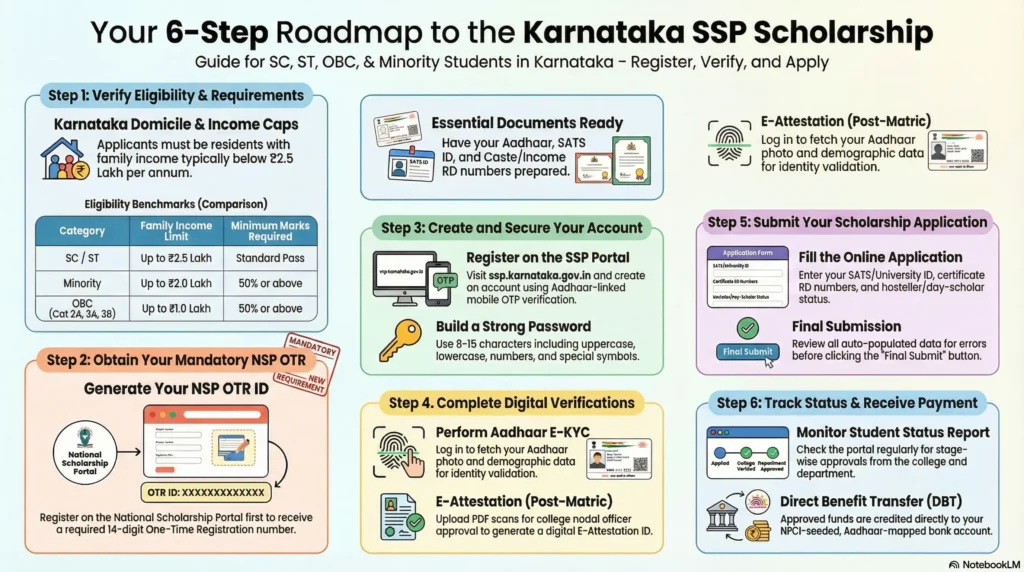
The 2025-26 academic cycle introduces a significant technical requirement designed to harmonize scholarship data at a national level: the mandatory One-Time Registration (OTR) from the National Scholarship Portal (NSP). This 14-digit unique identification number is now essential for every student applying for state-sponsored or centrally-sponsored schemes through the SSP.
Step-by-Step Instructions for Generating your NSP OTR
To successfully complete your SSP Scholarship 2025-26 application, you must secure your OTR ID via this technical workflow:
- Application Installation: Download the AadharFaceRD and NSP OTR apps from the Google Play Store.
- Initial Registration: On the NSP portal, click “Apply for OTR” and enter your Aadhaar-linked mobile number. This linkage is non-negotiable; if your mobile is not linked, the OTP cannot be received.
- e-KYC and Face Authentication: Open the NSP OTR app and perform face authentication. The system requires “liveness” detection, where the student must blink their eyes into the smartphone camera.
- Hardware Considerations & the Digital Divide: Students with low-quality smartphone cameras or unstable internet may face “Authentication Failed” errors. It is recommended to perform this in bright, natural light. This requirement assumes a level of digital literacy that can be a barrier for underserved communities; if hardware issues persist, students should visit a CSC (Common Service Center).
- ID Generation: Once successful, the system generates a 14-digit ID (e.g., KA2025XXXXXXXX).
- Integration: Return to the SSP portal and enter this OTR number in the “NSP Details” section to proceed.
Departmental Segmentation and Eligibility Landscape
The SSP ecosystem enforces eligibility through backend API calls to the Revenue Department. For the 2025-26 cycle, income limits have been strictly categorized.
Karnataka SSP Eligibility Matrix 2025-26
| Department / Board | Target Beneficiary | Income Limit (Annual) | Key Benefit |
| Social Welfare Dept. | Scheduled Castes (SC) | ≤ ₹2.5 Lakh | Full Fee + Maintenance |
| Tribal Welfare Dept. | Scheduled Tribes (ST) | ≤ ₹2.5 Lakh | Specialized Grants |
| Backward Classes (BCW) | OBC (Category 1) | ≤ ₹2.5 Lakh | Vidyasiri & Fee Concession |
| Backward Classes (BCW) | OBC (2A, 3A, 3B) | ≤ ₹1 Lakh | Tuition Fee Reimbursement |
| Minority Welfare | Muslim, Christian, Sikh, etc. | ≤ ₹2 Lakh | Merit-cum-means & Fee support |
| Brahmin Development Board | Brahmin (EWS) | ≤ ₹8 Lakh | Financial support for EWS |
| Dept. of Technical Edu. | Engineering/Diploma | Category-based | Tiered fee waivers |
Expert Tip: Raitha Vidya Nidhi “Double Benefit” The Raitha Vidya Nidhi scheme (Dept. of Agriculture) is a unique, non-caste-based initiative. The only requirement is a valid FRUITS ID (linked to a farmer’s land records). Crucially, this is a Double Benefit scheme: students can often receive this scholarship in addition to their category-based scholarships (SC/ST/OBC), allowing them to bypass traditional financial restrictions and maximize aid.
Maintenance Allowance: Group-Wise Classification
A common point of confusion is the varying scholarship amounts. The SSP categorizes courses into four “Groups” to determine the maintenance allowance:
- Group I: Professional courses like Medicine (MBBS), Engineering (BE/BTech), and PhD/Post-Doctoral research. These receive the highest maintenance grants.
- Group II: Professional PG courses like MBA, MCA, and LLB, along with Nursing and Pharmacy.
- Group III: General Undergraduate degrees (BA, BSc, BCom) and specialized diplomas.
- Group IV: Pre-University (PUC) Class 11 and 12, and vocational ITI courses.
Students in hostels (hostellers) receive a significantly higher allowance than day scholars to account for accommodation and food costs.
Mandatory Document Checklist: The “Paperless” Model
The SSP has transitioned to a “paperless” verification model. Instead of uploading physical scans, you provide unique IDs that allow the system to fetch data directly from government servers.
- Aadhaar Number: Must be linked to an active mobile number for Identity Validation.
- RD Numbers (15-digit): Found on Caste and Income certificates. This allows the portal to pull data directly from the Bhoomi system.
- SATS ID (9-digit): Required for Pre-Matric students to verify attendance and academic history.
- University Registration Number: For Post-Matric students to verify current enrollment.
- NSP OTR Number: The 14-digit national ID (Mandatory for 2025-26).
- FRUITS ID: Only for applicants of the Raitha Vidya Nidhi scheme.
- UDID Number: For students with disabilities to pull data from the Central Depository.
Operational Workflow: Step-by-Step Registration Guide
Phase 1: Account Creation
- Access: Visit
ssp.karnataka.gov.in. - Aadhaar Authentication: Enter your Aadhaar number and select your department.
- Identity Validation: The system opens the “Identity Validation Service.” Select “SSP Scholarship Registration” as the purpose.
- OTP Verification: Enter the OTP sent to your Aadhaar-linked mobile.
Expert Tip: Password Complexity The SSP system requires a password of 8-15 characters. It must include one Uppercase letter, one Lowercase letter, one Number, and one Special Character (e.g., @, #, $). I strongly recommend taking a screenshot of your generated SSP ID and password, as the automated SMS confirmation is often delayed by high server traffic.
Phase 2: Form Submission
- Course Info: Enter your University Registration number or SATS ID.
- E-Attestation IDs: Input IDs for documents not part of the state’s digital database.
- NSP Details: Enter your 14-digit OTR number.
- Finalize: Cross-check auto-populated data from Kutumba and the Revenue Department before the “Final Submit.”
Understanding E-Attestation and E-KYC
E-Attestation (eattestation.ssp.karnataka.gov.in) is the digital bridge for non-digitized documents like study certificates or hostel stay certificates.
The Workflow:
- Upload: Submit high-quality PDF scans to the e-attestation portal.
- Nodal Officer Verification: The officer at your institution checks the digital upload against physical records.
- Receipt of ID: Once approved, an E-Attestation ID is generated. You must manually enter this ID into your main SSP application.
Direct Benefit Transfer (DBT) and NPCI Mapping
Funds are disbursed via the Aadhaar Payment Bridge System (APBS). A student’s bank account must be NPCI mapped to receive funds.
Troubleshooting DBT Status Codes
| Status Code | Meaning | Required Action |
| Awaited | System is verifying if the account is NPCI-linked. | Note: There is a 14-day reflection lag. Wait 2 weeks after banking. |
| Push to DBT | Funds sent to the payment gateway. | Funds arrive in 3-5 working days. |
| Sent to Treasury | Government has released the payment. | Delay lies with the bank; monitor your account. |
| NPCI Mapping Failed | Account not linked to Aadhaar bridge. | Visit bank; submit “DBT Consent / NPCI Mapping Form.” |
Tracking Your Application: Verification Hierarchy
Use the “Year Wise Student Status” report to monitor progress:
- Institute Level: Verified by the college Nodal Officer.
- District Level: Checked for income and academic validity.
- State/Ministry Approval: The final sanctioning of the scholarship amount.
- Payment Initiated (DBT): The final stage of electronic transfer.
Search Trends and User Intent: Strategic Analysis
As a Senior SEO Strategist, I have analyzed search behaviors surrounding the SSP. Student intent follows a distinct seasonal lifecycle:
- July – October (Discovery Phase): High volume for keywords like “SSP Scholarship 2025-26 Last Date” and “SSP Login.” Users are seeking eligibility and registration guides.
- November – December (Technical Friction Phase): Searches shift toward “SSP OTR Registration” and “Face Authentication Failed.” This indicates technical barriers in the application process.
- January – March (Troubleshooting Phase): The dominant queries are “SSP Status Awaited” and “NPCI Mapping Failed.” Intent has shifted from “Discovery” to “Grievance Redressal.”
Understanding this shift is vital; if your status is “Awaited,” you are in the high-volume troubleshooting pool. Remember the 14-day lag mentioned in Section 8—repeatedly searching for status won’t speed up the backend banking sync.
Troubleshooting Common Rejections and Technical Errors
- Name Mismatch: If SATS data doesn’t match Aadhaar, the application is flagged as “Defective.” Rectify this at Aadhaar centers immediately.
- Expired RD Numbers: The system cross-references the Revenue database. If your certificate is expired, the system blocks progress.
- Unauthorized Activity Detected: This error occurs during high server load. My recommendation is to perform final submissions during off-peak hours (10 PM – 7 AM).
- “Resubmit” Button Glitch: If the portal asks for resubmission after a confirmation email, it’s a database lag. Check your status again after 48 hours before attempting a duplicate submission.
Comparative Analysis: SSP Karnataka vs. Other States
Karnataka’s SSP is a national leader in digital welfare maturity. In the State Scholarship Portal Maturity Assessment, Karnataka consistently ranks as the top performer with a score of approximately 90%.
- Karnataka (SSP ~90%): Best-in-class due to deep integration with SATS and Kutumba, enabling proactive welfare.
- Uttar Pradesh (UP Scholarship ~70%): Strong due to massive application volumes but lacks the same level of granular data integration as Karnataka.
- Maharashtra (MahaDBT ~60%): Offers high income caps (up to ₹8 Lakh for various schemes) but has lower scores for real-time data granularity.
- Madhya Pradesh (SSP 2.0): Features over 4,800 registered institutions but has faced intermittent accessibility issues compared to the stable Karnataka backbone.
Official Support and Helpdesk Information
| Department | Phone Number | Email ID |
| Universal Helpline | 1902 | helpdesk.ssp@karnataka.gov.in |
| Social Welfare (SC) | 080-22634300 | swdcontrolroom@gmail.com |
| Backward Classes (OBC) | 8050770004 | bcwd.scholarship@karnataka.gov.in |
| Minority Welfare | 8277799990 | gokdomssp@gmail.com |
| Kutumba Helpline | 080-22371030 | N/A |
Important Dates and Deadlines (2025-26)
- Social Welfare (SC): Pre-Matric: Jan 15, 2026; Post-Matric: Jan 31, 2026.
- Tribal Welfare (ST): Pre-Matric: Jan 15, 2026; Post-Matric: Feb 15, 2026.
- Engineering & Medical (OBC/Minority): Deadline: January 31, 2026.
- OBC General Degree: Deadline: March 31, 2026.
- Raitha Vidya Nidhi: Deadline: March 31, 2026.
Conclusion: The Future of Proactive Welfare
The SSP Karnataka 2025-26 cycle represents a move toward “Predictive Welfare.” By integrating Face Authentication and the mandatory NSP OTR, the state is creating a frictionless environment where the government can identify and enroll beneficiaries automatically using Kutumba data.
To ensure you are part of this safety net, the most critical action you must take today is to verify your NPCI mapping status at your bank branch. Without a successful Aadhaar-Bank link, the most sophisticated digital portal in India cannot deliver the financial aid you deserve. Secure your educational future by addressing your “data hygiene” today.