Introduction to BBMP Property Tax
As a seasoned Bengaluru Real Estate & Taxation Consultant, I often remind property owners that property tax is more than just a fiscal obligation; it is the lifeblood of our city’s urban maintenance. Formally governed by the Bruhat Bengaluru Mahanagara Palike (BBMP) Act 2020, this annual levy is mandatory for every property owner within the municipal limits. Whether you own a luxury villa in Lavelle Road, a commercial storefront in Chickpet, a tech-park unit in Mahadevapura, or a vacant plot on the outskirts, you are liable to contribute.
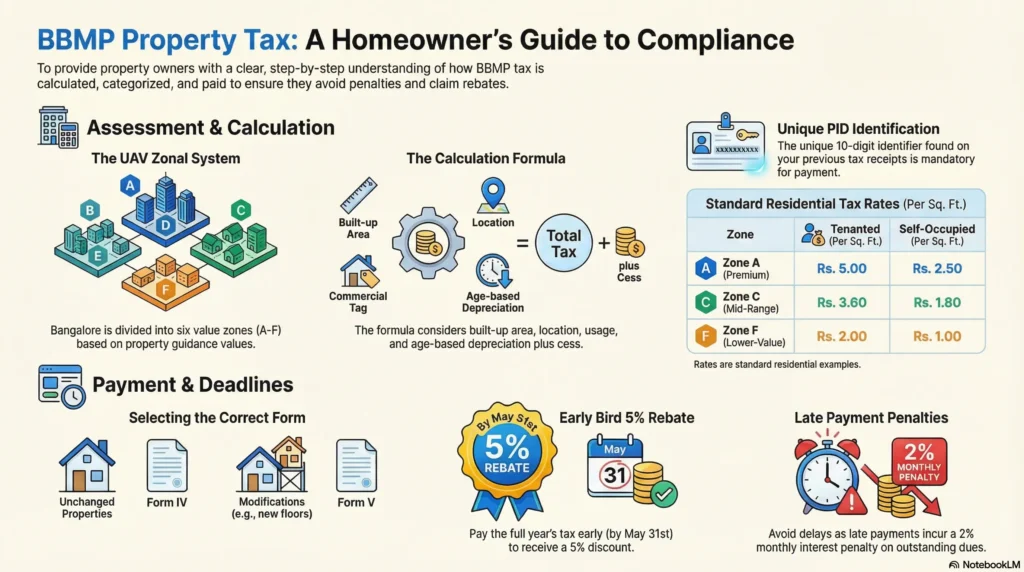
The revenue collected through the Self-Assessment Scheme (SAS) directly funds the “Socio-Fiscal” architecture of Bengaluru. This includes the upkeep of over 80,000 km of roads, the management of sophisticated drainage systems to prevent monsoon flooding, and the massive logistics required for Solid Waste Management (SWM). For the assessment year 2025-26, the BBMP has emphasized digital compliance and updated zonal classifications, making it imperative for owners to understand the technical nuances of the Unit Area Value (UAV) system.
Understanding the Unit Area Value (UAV) System
Bengaluru does not use a “Rental Value” or “Capital Value” system, which can be subjective. Instead, the BBMP utilizes the Unit Area Value (UAV) methodology. This system calculates tax based on the expected returns from a property, categorized by its location and the “per square foot” value of the area.
The city is divided into six distinct value zones (Zones A through F). These zones are determined based on the guidance values published by the Department of Stamps and Registration. Zone A represents premium, high-demand areas with the highest tax rates, while Zone F comprises the most affordable localities with the lowest tax burden.
Property Tax Rate in Bangalore for Residential Properties (per sq. ft. per month)
The following rates apply to residential structures based on their occupancy status. Note that tenanted properties carry a significantly higher tax weight than self-occupied ones.
| Zone | Tenanted (per sq. ft.) | Self-occupied (per sq. ft.) |
| Zone A | Rs. 5.00 | Rs. 2.50 |
| Zone B | Rs. 4.00 | Rs. 2.00 |
| Zone C | Rs. 3.60 | Rs. 1.80 |
| Zone D | Rs. 3.20 | Rs. 1.60 |
| Zone E | Rs. 2.40 | Rs. 1.20 |
| Zone F | Rs. 2.00 | Rs. 1.00 |
Property Tax Rate in Bangalore for Commercial Properties (per sq. ft. per month)
Commercial properties are categorized separately and attract higher rates to reflect their revenue-generating potential.
| Zone | Tenanted (per sq. ft.) | Self-occupied (per sq. ft.) |
| Zone A | Rs. 20.00 | Rs. 10.00 |
| Zone B | Rs. 14.00 | Rs. 7.00 |
| Zone C | Rs. 10.00 | Rs. 5.00 |
| Zone D | Rs. 8.00 | Rs. 4.00 |
| Zone E | Rs. 6.00 | Rs. 3.00 |
| Zone F | Rs. 3.00 | Rs. 1.50 |
Comprehensive Guide to BBMP Property Tax Forms (I – VI)
Navigating the BBMP forms requires an understanding of the legal distinction between Property Register A and Property Register B. As per the BBMP SOP 2023, Register A is reserved for lawful, authorized properties that comply with all KTCPA and BBMP bylaws. Register B is utilized for properties that are unauthorized, constructed in violation of bylaws, or built on revenue land without proper conversion.
Consultant’s Note: Paying tax under Register B (Forms II and IV in the physical register context) does not confer legal title or regularize a violation. It is purely a tax collection mechanism for the municipal body.
| Form Number | Category | Eligibility and Usage |
| Form I | PID Holders | For owners with a Property Identification Number (PID). Corresponds to Register A. |
| Form II | Khata Holders | For owners who have a Khata number but no PID. Often corresponds to Register B. |
| Form III | Survey Number | For owners with only a Survey Number (no PID or Khata). Corresponds to Register A. |
| Form IV | White Form | Used for renewal of tax returns where there are no changes in property extent or usage. |
| Form V | Blue Form | Used when changes or alterations have occurred (e.g., residential to commercial use, or new floors). |
| Form VI | Tax Exempt | Used for properties exempt from tax but requiring a mandatory assessment filing. |
How to Calculate BBMP Property Tax 2025-26
The final tax amount is a composite of the base tax, statutory cesses, and the Solid Waste Management (SWM) Cess.
The Primary Formula
Total Tax = [(G – I) * 20%] + Cess (24% of property tax) + SWM Cess
Definition of Variables
- G (Gross Unit Area Value): Calculated as
X + Y + Z.- X: Tenanted area × per sq. ft. rate × 10 months.
- Y: Self-occupied area × per sq. ft. rate × 10 months.
- Z: Parking area × (50% of applicable rate) × 10 months.
- I (Depreciation): Calculated as
G * H / 100. The variable H is the percentage based on the age of the building (per the BBMP depreciation schedule). - Statutory Cess: A flat 24% is applied to the 20% base tax. This supports library, health, and infrastructure funds.
- SWM Cess: This is a fixed monthly fee (e.g., ₹360 for certain residential slabs) added at the final step of the calculation, as seen in the official SOP Form 5.
Authorities for Approval and Assessment
A common point of confusion for property owners is knowing which official has the jurisdiction to approve their assessment or handle appeals. Under the latest Standard Operating Procedure (SOP), authorities are assigned based on the extent of the property (square footage):
| Property Extent (Land with/without Building) | Approval Authority |
| Up to 2400 Sq. Feet | Assistant Revenue Officer (ARO) |
| 2401 to 4000 Sq. Feet | Deputy Revenue Officer / Revenue Officer |
| 4001 to 6000 Sq. Feet | Zonal Deputy Commissioner (Revenue) |
| More than 6000 Sq. Feet | Zonal Additional / Joint Commissioner |
How to Find Your BBMP PID Number via GEPTIS
The Property Identification Number (PID) is a 10-digit unique code. If you are a new owner or have misplaced your PID, you must use the GEPTIS (GIS-enabled Property Tax Information System).
- Visit the Portal: Go to the official BBMP site and click the GEPTIS link.
- Registration: Sign in with your mobile number. New users must register to see the GIS-mapped properties.
- Map Interface: The portal uses a Google Maps overlay. Navigate to your specific plot.
- Retrieve ID: Hover over your property footprint. A pop-up will display the New PID Number, Ward details, and Owner Name.
- Search Data: Use this PID on the main tax portal to retrieve your historical tax data.
Step-by-Step Guide: Online Property Tax Payment
Digital payment is the recommended mode for 2025-26 to ensure immediate receipt generation.
- Access: Go to https://bbmptax.karnataka.gov.in/.
- Retrieve: Enter your PID or Application Number and the owner’s name.
- Validate: Confirm that the displayed property details match your records.
- Form Selection:
- Select Form IV if your property status is identical to last year.
- Check the “Changes” box to select Form V if you have added built-up area or changed usage.
- Payment: Use Credit/Debit Card, Net Banking, or UPI.
- Receipt: The receipt is available for download exactly 24 hours after the transaction via the “Downloads” section.
Offline Payment Options and Locations
For taxpayers who prefer manual processing:
- Locations: Visit Bangalore One Centres or the Assistant Revenue Office (ARO).
- Modes: Only Demand Draft (DD) or Credit Card are accepted. Cash is restricted to very low limits set by the Commissioner.
- Process: Submit the filled physical form (matching the SAS data) and collect a printed acknowledgement.
Critical Deadlines, Rebates, and Penalties for 2025-26
Timing is everything in property tax. Missing the window for a rebate can cost thousands in unnecessary interest.
- 5% Rebate (Early Bird): If you pay the full annual tax in a single installment, you are eligible for a 5% discount.
- Crucial 2025 Update: While the deadline is traditionally April 30, the BBMP has officially extended the 5% rebate deadline to May 31, 2025, due to portal transitions.
- 2% Monthly Penalty: Payments made after the due date attract a 2% interest penalty per month. This is cumulative, making it one of the highest interest rates for municipal defaults.
- Installment Option: You can pay in two installments (April and November). However, paying in installments disqualifies you from the 5% rebate.
Recovery Procedures and Legal Consequences
The BBMP Act 2020 (Section 156) provides the municipal body with sweeping powers for the recovery of “tax in arrears.”
The SOP Enforcement Hierarchy:
- Form 5 (Demand Notice): Served when tax is overdue. You have 30 days to pay.
- Form 6 (Show Cause Notice): Issued for reassessment if an audit (often via the Revenue Inspector) finds under-declaration. You have 15 days to file an objection.
- Service by Affixture (Form 8 – Panchanama): If an owner avoids notice service, the ARO will affix the notice to the property in the presence of two independent witnesses (respectable locals), taking video/photo evidence.
- Warrant of Attachment: The BBMP can issue warrants to freeze bank accounts (Form 16) or attach the property.
- Distraint and Seizure (Form 9): Authorized officers may seize movable property (vehicles, machinery) for public auction.
- Upset Price & Auction: For seized property, a Minimum Auction Price (Upset Price) is fixed by the Zonal Joint Commissioner. If bids don’t meet this price, the auction is postponed.
Property Maintenance: Up-dation and Mutation
Updating property records is often overlooked but critical for legal sales or inheritances. Under SOP Section 8, mutation is handled via specific forms:
- Form 18: Intimation slips from the Sub-Registrar after a property sale.
- Form 19/20: Registers maintained by the ARO for recording mutations and inheritances.
- Form 21: Intimation for mutation by inheritors in the event of the owner’s death.
- Form 22: Direct application by a purchaser to update records if the Sub-Registrar’s slip is delayed.
BBMP Zonal Classification: Comprehensive Ward & Sub-Division Directory
Identify your zone using this exhaustive directory to ensure you apply the correct UAV rate.
WEST ZONE
- Chickpet: Wards 109 (Chikpet), 120 (Cottonpet), 121 (Binnypet).
- Gandhinagar: Wards 77 (Dattathreya Temple), 94 (Gandhinagar), 95 (Subhashnagar), 96 (Okalipuram).
- Rajajinagar: Wards 99 (Rajajinagar), 100 (Basaveshwaranagar), 101 (Kamakshipalya), 107 (Shivanagar).
- Malleshwaram: Wards 64 (Rajamahal), 65 (Kadumalleshwara), 66 (Subramanyanagar), 76 (Gayathrinagar).
- Govindrajanagar: Wards 103 (Kaveripura), 104 (Govindrajnagara), 105 (Agrahara Dasarahalli), 106 (Dr. Rajkumar Ward), 125 (Marenahalli).
- Additional Sub-Divisions: Jagajeevanram Nagar, Chamarajpet, Chandralayout, Srirammandira, Mathikere, Nagapura, Mahalakshmi Layout.
SOUTH ZONE
- Jayanagar: Wards 153 (Jayanagar), 168 (Pattabhiramnagar), 169 (Byrasandra), 170 (Jayanagar East).
- Koramangala: Wards 147 (Adugodi), 148 (Ejipura), 151 (Koramangala), 173 (Jakkasandra).
- B.T.M. Layout: Wards 146 (Lakkasandra), 152 (Sudduguntepalya), 172 (Madiwala), 176 (BTM Layout).
- Padmanabha Nagar: Wards 161 (Hosakerehalli), 181 (Kumaraswamylayout), 182 (Padmanabhanagar), 183 (Chikkallasandra).
- Basavanagudi: Wards 154 (Basavanagudi), 155 (Hanumanthanagar), 164 (Vidyapeetha Ward).
- Additional Sub-Divisions: Kempegowda Nagar, Hombegowda Nagar, Vijayanagar, Gali Anjaneyaswamy Temple, Girinagar, Banashankari, J.P. Nagar.
EAST ZONE
- Hebbal: Wards 18 (Radhakrishna Temple), 19 (Sanjaynagar), 20 (Ganganagar), 21 (Hebbal).
- Shivajinagar: Wards 90 (Ulsoor), 91 (Bharathinagar), 92 (Shivajinagar).
- Shanthinagar: Wards 111 (Shanthala Nagar), 116 (Neelasandra), 117 (Shanthinagar).
- C.V. Ramannagar: Wards 50 (Benniganahalli), 57 (C.V. Ramannagar), 58 (Hosathippasandra), 79 (Sarvagnanagar).
- H.B.R. Layout: Wards 23 (Nagavara), 24 (HBR Layout), 29 (Kacharakanahalli), 30 (Kadugondanahalli).
- Additional Sub-Divisions: J.C. Nagar, K.G. Halli, Pulikeshinagar, Maruthisevanagar, Jeevanbhimanagar, Domlur, Vasanthanagar.
YELAHANKA ZONE
- Yelahanka: Wards 1 (Kempegowda), 2 (Chowdeshwari).
- Byatarayanapura: Wards 5 (Jakkur), 6 (Thanisandra), 7 (Byatarayanapura).
- Vidyaranyapura: Wards 9 (Vidyaranyapura), 10 (Doddabommasandra), 11 (Kuvempunagar).
- Additional Sub-Divisions: Yelahanka Satellite Town, Kodigehalli.
MAHADEVAPURA ZONE
- Whitefield: Wards 83 (Kadugodi), 84 (Hagadooru), 149 (Varthur).
- Marathalli: Wards 86 (Marathalli), 150 (Bellandur).
- HAL Airport: Wards 56 (A. Narayanapura), 81 (Vignananagar), 87 (HAL Airport).
- Additional Sub-Divisions: Horamavu, K.R. Puram, Hoodi.
BOMMANAHALLI ZONE
- HSR Layout: Wards 174 (HSR Layout), 190 (Mangammanapalya).
- Begur: Wards 191 (Singasandra), 192 (Begur).
- Uttarahalli: Wards 184 (Uttarahalli), 197 (Vasanthapura).
- Additional Sub-Divisions: Bommanahalli, Arakere, Anjanapura, Yelachenahalli.
RAJARAJESHWARI NAGAR (RR NAGAR) ZONE
- RR Nagar: Wards 160 (Rajarajeshwarinagar), 129 (Jnanabharathi).
- Yeshwanthpur: Wards 16 (Jalahalli), 17 (J.P. Park), 37 (Yeshwanthpur).
- Kengeri: Wards 130 (Ullalu), 159 (Kengeri), 198 (Hemmigepura).
- Additional Sub-Divisions: Laggere, Lakshmidevinagar, Herohalli.
DASARAHALLI ZONE
- T-Dasarahalli: Wards 14 (Bagalagunte), 15 (T. Dasarahalli).
- Peenya Industrial Area: Ward 39 (Chokkasandra), 41 (Peenya Industrial Area).
- Additional Sub-Divisions: Shettyhalli, Hegganahalli.
Frequently Asked Questions (FAQs)
What is BBMP Property Tax?
It’s a mandatory annual fee for property owners in Bangalore, covering residential, commercial, and vacant lands.
How is BBMP Property Tax Calculated? (The UAV System)
Bangalore uses the Unit Area Value (UAV) system, which categorises the city into six value zones (A through F) based on guidance values.
How to Find Your BBMP PID Number
Your Property Identification Number (PID) is a unique 10-digit code assigned to your property.
How to Pay BBMP Property Tax Online
Skip the queues and pay from home via the official BBMP property tax portal. [https://bbmptax.karnataka.gov.in/]
Can I pay my property tax if I only have a B-Khata?
Yes. You should use Form II or Form IV (if renewing). The BBMP accepts tax from unauthorized properties under Section 144(6), but remember: tax payment does not legalize the property structure.
I missed the May 31 rebate deadline. Can I still get a discount?
No. After May 31, the 5% rebate expires. From June 1 onwards, you will not only lose the rebate but may also be liable for the 2% monthly interest if the full payment window for the first half-year is closed.
How is the age of the building calculated for depreciation?
Depreciation is based on the year of construction as mentioned in your completion certificate or previous tax filings. The rate (H) reduces the Gross Unit Area Value, providing relief for older structures.
What happens if my tax payment cheque is dishonored?
The BBMP takes this seriously. Apart from the tax remaining “unpaid” and attracting a 2% penalty, you will face criminal prosecution under the Negotiable Instruments Act.
Is the SWM Cess mandatory for vacant land?
No. The Solid Waste Management (SWM) user fee is generally applicable only to built-up properties (residential and commercial) where waste generation occurs.
Conclusion
The BBMP Property Tax 2025-26 cycle represents a push toward total digital transparency. As a consultant, I cannot stress enough the importance of filing accurately under the Self-Assessment Scheme. The BBMP is increasingly using GIS mapping (GEPTIS) and Revenue Inspector audits to cross-reference self-declared built-up areas with reality.
Under-declaring your property by more than 5% can lead to heavy penalties—specifically, twice the evaded tax plus 24% annual interest. Avoid the 2% monthly late-fee and capitalize on the extended May 31st rebate deadline. By staying compliant, you ensure your property remains free of legal encumbrances while contributing to the infrastructure that makes Bengaluru a global tech hub.