Introduction – Your Gateway to Professional Success in Karnataka
Welcome to the start of your professional journey. If you are an aspirant looking to secure a seat in engineering, medicine, or postgraduate studies in Karnataka, the Karnataka Examinations Authority (KEA) is the single most important institution you will encounter. In my 15 years of navigating the state’s admission cycles, I have seen the KEA transform from its humble beginnings as the 1994 CET Cell into the statutory powerhouse it is today.
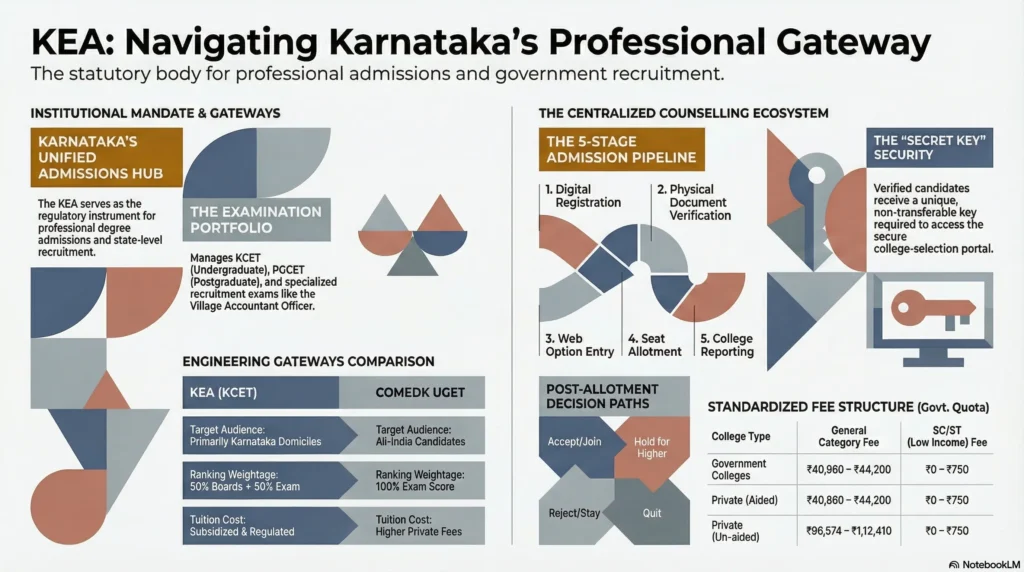
The Karnataka Examinations Authority is no longer just an exam body; it is the gatekeeper of merit, social equity, and professional standards in the state. My mission with this guide is to act as your mentor, stripping away the technical jargon and simplifying the complex journey from your first digital application to your final college placement. Don’t let the administrative layers intimidate you—with the right strategy, this process is entirely manageable.
Keyword Data & Strategic Intent
This guide is structured to address your most pressing concerns. Below are the key terms you will encounter, along with the strategic role they play in your admission lifecycle.
| Keyword | Search Intent Cluster | Student Concern Addressed |
| KEA Option Entry | Transactional (Action-oriented) | How and when to prioritize college preferences to ensure a seat. |
| KCET Verification Slip | Navigational / Urgent | Obtaining the “Secret Key” required to unlock the allotment portal. |
| KEA Seat Matrix | Informational (Strategic) | Analyzing the availability of seats across categories like SNQ, HK, and RK. |
| RD Number Correction | Pain Point / Troubleshooting | Fixing Revenue Department document errors during the critical “Edit Window.” |
| KCET 2026 Syllabus | Informational (Long-term) | Aligning board exam preparation with the KEA’s entrance requirements. |
Decoding the KEA – History, Governance, and IAS Leadership
The KEA is not a mere department; it is a statutory body registered under the Societies Registration Act of 1960. This status, granted in 2006, provides the authority with the financial and operational autonomy needed to manage hundreds of thousands of applicants without typical bureaucratic delays.
Administrative Rigor
The KEA’s governance is anchored by a tripartite model that ensures high-level accountability. I often tell parents that the KEA’s decisions carry the weight of the highest offices in the state:
- General Body: This is the supreme policy-making unit, chaired by the Chief Minister and the Higher Education Minister, ensuring that admission policies align with state developmental goals.
- Executive Committee: The primary decision-making organ, responsible for the actual execution of exams and ratification of results.
- Secretariat: The operational wing managing records, finances, and the digital infrastructure.
In mid-2024, following the “out-of-syllabus” question controversy, the state appointed H. Prasanna, IAS, as the Executive Director. This move marked a significant “administrative reset,” prioritizing transparency and technological upgrades to restore student confidence.
The Examination Portfolio – More Than Just KCET
While most know the KEA for engineering, its portfolio covers the entire spectrum of higher education and state recruitment.
KCET (UGCET) – The Undergraduate Powerhouse
The KCET is the primary route for Karnataka residents to secure subsidized seats. The Consultant’s Insight: One of the most critical aspects of KCET is its 50:50 ranking formula. This balances entrance scores with Class 12 Board marks. In my experience, I have seen students “rescue” a mediocre CET performance with exceptional Board marks. Never neglect your school exams; they are 50% of your professional rank.
| Parameter | Specifications of the KCET |
| Frequency | Annual (typically April/May) |
| Mode | Offline (Pen-and-Paper/OMR) |
| Subjects | Physics, Chemistry, Mathematics, Biology |
| Marking Scheme | 60 questions per subject; No negative marking |
| Language | English and Kannada |
| Ranking Formula | 50% Entrance marks + 50% Class 12 Board (PCM) marks |
PGCET – Aiming for Masters
For those seeking an MBA, MCA, or M.Tech, the PGCET is the mandatory gateway. Unlike the undergraduate level, PGCET rankings are derived primarily from the entrance score.
| PGCET Section | Content Focus | Weightage |
| Proficiency in English | Grammar, Vocabulary, Comprehension | 20 Marks |
| General Knowledge | Business, Economics, Science, Sports | 20 Marks |
| Reasoning/Intelligence | Logical puzzles, Analytical ability | 20 Marks |
| Quantitative Analysis | Mathematics, Data Interpretation | 20 Marks |
| Computer Awareness | Basic hardware/software, algorithms | 20 Marks |
Specialized Streams
- DCET (Lateral Entry): For diploma holders entering the second year of engineering.
- PG AYUSH: Admissions for postgraduate Ayurveda, Unani, and Homoeopathy based on AIAPGET scores.
Eligibility and the Domicile Factor
Academic thresholds are non-negotiable. For Engineering, you generally require 45% in science subjects (PCM) at the 10+2 level. For Medical (NEET-UG), the bar is set at 50% in the qualifying exam plus the minimum percentile required by the National Medical Commission (NMC).
Domicile status is the KEA’s priority. Most seats are reserved for Karnataka residents. NRI and Foreign students follow a different protocol, involving significantly higher application fees (approx. ₹5,000) and a separate quota system.
The Step-by-Step Applicant Journey – From Portal to Placement
- Digital Registration: Register as a “New User.” Specialist Tip: Double-check your email and phone number; these are your lifelines for the entire year.
- The Edit Window: This is your one chance to fix RD Number errors or reservation claims. If your caste or income certificate numbers are wrong here, you could lose your eligibility for subsidized fees.
- Admit Card & Exam Day: Download your hall ticket online. Ensure your photo and signature are clearly visible.
- Results & Tie-Breakers: After provisional keys and grievances are handled, ranks are released. The KEA Tie-Breaker Logic: If two students have the same aggregate score, the KEA uses a strict hierarchy: 1. Mathematics marks, 2. Aggregate marks, 3. Candidate age (older candidates are prioritized).
The Masterclass in Counselling – Verification and the “Secret Key”
Counselling is where strategy matters most. It is a digital-first ecosystem that converts your rank into a college seat.
Document Verification
You must report to helpline centers with original certificates for domicile, caste, and income. If successful, you receive the Verification Slip containing your Secret Key. Guard this key; it is the only way to log into the option entry portal.
The Mechanics of Allotment
The “Choice 1 to Choice 4” logic requires careful thought:
- Choice 1: Satisfied. Pay fees and join.
- Choice 2: Satisfied but hopeful. You hold your current seat but stay in the mix for a higher priority. My Advice: This is the safest middle ground.
- Choice 3: Rejects the current seat. You stay in the process but lose the seat you currently have. I have seen students lose excellent colleges because they didn’t realize Choice 3 wipes their current allotment.
- Choice 4: Quits the process.
| Stage of Counselling | Objective | Candidate Action |
| Mock Allotment | Predictive distribution | Rearrange options based on the results. |
| Round 1 Allotment | Official first-round award | Exercise Choice 1, 2, 3, or 4. |
| Round 2 Allotment | Fill remaining seats | Modify or delete existing options. |
| Second Extended Round | Final vacancy round | Mandatory joining if a seat is allotted. |
The Competitive Landscape – KEA (KCET) vs. COMEDK
For Karnataka locals, KCET is the priority because of the heavily subsidized fees and access to government institutions like UVCE. COMEDK is a consortium of private colleges and is typically a backup for locals or the primary route for All-India candidates.
Competitor Comparison Table
| Competitive Factor | KEA (KCET) | COMEDK UGET |
| Target Audience | Primarily Karnataka Domiciles | All-India Candidates |
| Institutional Range | Govt, Aided, and Private | Only Private Un-aided |
| Ranking Weightage | 50% Boards + 50% Exam | 100% Exam Score |
| Tuition Cost | Subsidized and Regulated | Significantly Higher Fees |
| Difficulty Level | Conceptual/Syllabus-focused | Speed-focused/Application-oriented |
Understanding the Seat Matrix & Reservation Maze
Karnataka’s reservation system is arguably the most intricate in India. The seat matrix details how many seats are reserved for specific demographics.
| Reservation Category | Designation | Context and Impact |
| Rural (RK) | Rural Students | For those who studied in rural schools for 10 years. |
| 371(J) / HK | Kalyana Karnataka | Special quota for Northeast Karnataka districts. |
| SNQ | Supernumerary Quota | 5% extra seats for low-income candidates at deeply reduced fees. |
| Kannada Medium | Language Reservation | For students who studied in Kannada medium (1st-10th). |
Fee Structures – Budgeting for Your Education
The financial divide between Government and Private seats is vast. The SNQ quota is a vital safety net, offering high-merit candidates seats for as little as ₹20,000 to ₹30,000 annually.
Engineering Fee Structures
| College Type | General Category Fee | SC/ST (Income < ₹2.5L) |
| Government Colleges | ₹40,860 – ₹44,200 | ₹0 – ₹750 |
| Aided Courses | ₹40,860 – ₹44,200 | ₹0 – ₹750 |
| Un-aided (Type-1) | ₹96,574 – ₹1,12,410 | ₹0 – ₹750 |
| Private Universities | ₹96,574 – ₹1,12,410 | ₹0 – ₹750 |
Note: The near-zero fee for SC/ST students is strictly tied to a family income of less than ₹2.5L. Medical fees vary, from ₹64,350 at Bangalore Medical College to ₹45 lakh for private P-Category seats.
Cutting Through the Noise – Cutoff Trends & Projections
Computer Science (CSE) and its sub-branches (AI, ML) are the most competitive. However, the “rank drop” for core branches is significant—a student who can’t get CSE at RVCE might still find a seat in Mechanical or Civil with a much higher rank.
Historical Closing Ranks: The CSE vs. Core Gap (2021 Data)
At RV College of Engineering (RVCE), the 2021 closing ranks showed a massive disparity:
- CSE: 315
- Mechanical: 7,801
- Civil: 22,445
CSE Closing Rank Trends (2021-2024)
| College Name | 2021 CSE | 2023 CSE | 2024 CSE (Approx) |
| RVCE | 315 | 300 – 500 | Top 400 |
| PES University | 763 | 500 – 900 | Top 1000 |
| MS Ramaiah | 962 | Below 1000 | Top 1200 |
| BMSCE | 925 | 800 – 1100 | Top 1300 |
2026 Projections: Expect “rank inflation” as applicants exceed 3 lakh. The expansion of AI branches may slightly ease the pressure on pure CSE.
Real Talk – Navigating Tech Glitches and Controversies
I know the 2024 “out-of-syllabus” controversy caused a lot of anxiety. Fifty questions were eventually removed from ranking considerations. My advice during such times: stay calm and wait for official KEA circulars.
Pro-Tips for Portal Glitches:
- If your mother tongue or religion doesn’t update, try clearing your cache or using a different browser.
- The portal often lags during the final hours of Option Entry. Complete your list 24 hours before the deadline.
- Follow student communities on Reddit; they are often the first to find workarounds for software bugs.
The Future of KEA – Beyond Admissions
The KEA is evolving into a year-round recruitment agency (e.g., Village Accountant Officers). For future students, the “Digital Integration Phase” (2025-2026) is the most exciting development. We are moving toward “one-click registration” where document verification is automated through the state’s Kutumba or Bhoomi databases. This will effectively end the era of physical visits to helpline centers.
Conclusion – Final Checklist for Aspirants
Precision is your best ally in the KEA ecosystem. Before you submit any form, run through this mental checklist:
- Match Your Documents: Does your RD number on the portal match your certificate exactly?
- Protect Your Key: Is your Secret Key written down somewhere offline?
- Be Exhaustive: Is your Option Entry list long enough? Never list just five or ten colleges; list every institution you would be willing to attend.
The KEA is the engine of Karnataka’s professional future. By staying technically aware and strategically prepared, you aren’t just applying for a seat—you are securing your career. Good luck, and may your rank lead you to your dream campus!