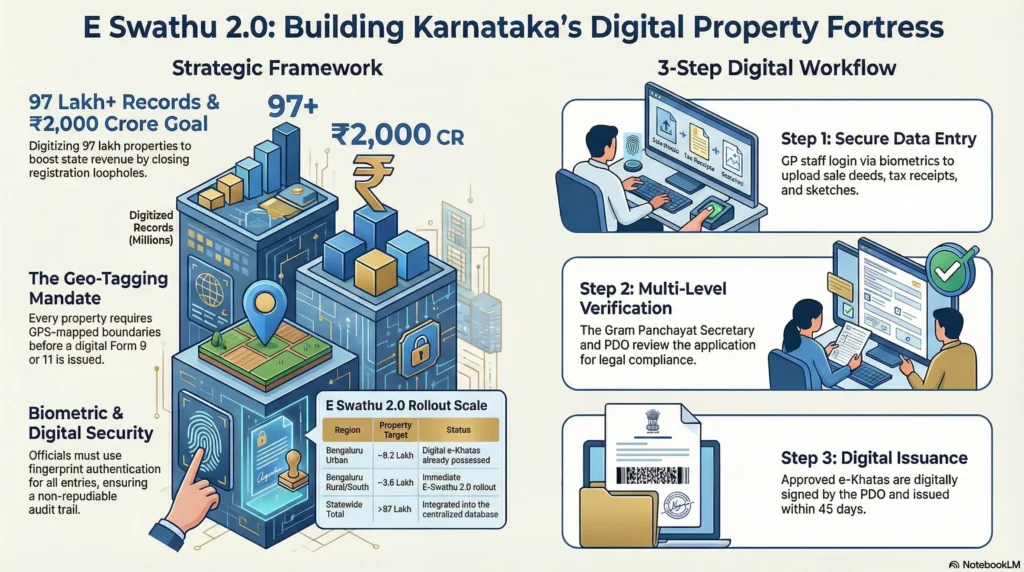
The landscape of rural property management in Karnataka has undergone a monumental shift from a fragmented, manual system prone to manipulation to a centralised, workflow-based digital infrastructure known as E Swathu. Launched in 2021 and significantly upgraded to version 2.0 in late 2025, this portal serves as the definitive repository for ownership and physical attributes of properties within the jurisdiction of over 6,000 Gram Panchayats. Managed by the Rural Development and Panchayat Raj (RDPR) Department, the system now digitises over 97 lakh rural property records to prevent forgeries and regulate unauthorised layouts. Whether you are a first-time buyer in a peri-urban area or a long-time landowner, understanding this “Digital Fortress” is essential for legal property security in 2026.
What is E Swathu?
E Swathu is an online portal designed by the Government of Karnataka to manage and store property-related documents for rural areas. The name itself is derived from “E” (electronic) and “Swathu” (property in Kannada). The system was conceptualised following critical vulnerabilities identified in legacy demand registers, where fake records were frequently used for illegal property registrations.
The portal functions as a centralised platform that enables property owners to access their e-Khata, established to clarify ownership rights and document changes in title due to sale, inheritance, or gifts. By moving away from manual record-keeping, E Swathu eliminates the apathy previously associated with managing rural property papers and prevents the sale of agricultural lands as residential sites under the guise of “Gramathana”. This project moves Karnataka closer to a completely transparent land governance model where every transaction is verifiable and tamper-proof.
Key Features and Benefits of E Swathu
The E Swathu portal brings several transformative features aimed at protecting citizens from property fraud:
• Ownership Verification: It clarifies ownership rights for rural properties, establishing a clear legal chain of title.
• Digital Signatures: Every form issued, such as Form 9 or Form 11, is digitally signed by the Panchayat Development Officer (PDO). These carry a unique certificate number and a 2D barcode for instant verification, eliminating the need for traditional ink signatures.
• Inter-Departmental Integration: The portal is integrated with Bhoomi (for agricultural land records), the Kaveri portal (for property registration), and BESCOM (for electricity connection details).
• Transparency in History: All details related to transfers, court cases, liabilities, and government acquisitions are documented and accessible online.
• Multilingual Support: While primarily in Kannada, the portal offers English translation options to improve accessibility for a wider audience.
By providing 24/7 access to digital land records, the system saves citizens from making repeated visits to Gram Panchayat offices and significantly reduces the influence of middlemen.
Understanding Form 9 and Form 11
In the E Swathu ecosystem, two primary documents serve as the foundation for rural property legality.
Form 9: The A-Khata for Rural Areas
Also known as the Property Register Extract, Form 9 is issued exclusively for non-agricultural properties registered with the Gram Panchayat. It certifies that a specific land parcel is legally recognised and included in the official register. To qualify for Form 9, a property must meet strict criteria:
1. It must be legally converted from agricultural to non-agricultural use under the Karnataka Land Revenue Act, 1964.
2. It must possess sanctions and approvals from the relevant Town and Country Planning authorities.
3. It must be verified by a Tehsildar and located within the village “Gramathana” (habitated area).
4. It is often issued to beneficiaries of government housing schemes like Basava Vasati or Indira Awaas Yojana.
Form 11: Mutation and Tax Records
Form 11 is an extract from the Register of Demand, Collection, and Balance of Land and Building. It serves as official proof of mutation, documenting any change in ownership resulting from sale, inheritance, or gifts.
• Form 11A: Issued alongside Form 9 for properties that meet full conversion criteria.
• Form 11B: Often functioning as a “B-Khata” equivalent, this is issued for properties that are registered for tax collection purpose but may not meet the full regulatory conversion requirements for an A-Khata.
These forms are mandatory for selling property, registering new deals, and securing bank loans or mortgages.
How to Download E Swathu Forms Online
Citizens can retrieve their property documents effortlessly through a structured online process:
1. Visit the Official Portal: Access eswathu.karnataka.gov.in.
2. Search Your Property: Click the “Search Your Property” option on the main menu.
3. Enter Location Details: Select your District, Block, Gram Panchayat, and Village from the dropdown menus.
4. Enter Property ID: Provide the unique Property Identification number. This ID also acts as the password to open the downloaded PDF document.
5. Download and Print: Click “Search” to view the details and then click the document number to download the digitally signed Form 9 or Form 11.
To verify the genuineness of a form you already possess, use the “Verify Documents” tab and enter the certificate number to instantly view the record’s authenticity.
E Swathu 2.0: Geo-Tagging and the “Digital Fortress”
Launched in late 2025, E Swathu 2.0 represents a major technological leap aimed at ending land fraud. The cornerstone of this upgrade is mandatory geo-referencing.
• GPS Mapping: The system will not issue a Form 9 or 11 until the property’s physical boundary is mapped using GPS coordinates.
• Unique PID Number: Geo-tagging creates a unique Property Identification (PID) number that links the digital file directly to a specific spatial location on the ground.
• Abolishing Fake Claims: Because the land is linked to a digital map, it is impossible for individuals to claim ownership of land that does not exist in the government’s spatial database.
• Identifying Illegal Subdivisions: The system automatically flags plots created by illegally splitting agricultural land without proper conversion orders.
The Karnataka government expects this “Digital Fortress” to boost state revenue by approximately INR 2,000 crore by ensuring every legal sale is recorded at its true value, capturing all appropriate stamp duties.
Troubleshooting Common Issues
Despite the system’s robustness, users frequently encounter hurdles documented through public feedback and community discussions.
Identity Matching and Aadhaar Glitches
A prominent issue is the “Identity Matching Problem”. Minor variations in name initials or spelling between a sale deed and the Aadhaar database can halt automated mutation processes, often requiring manual intervention at the Gram Panchayat office. Users have reported that XML data uploads sometimes error out, leaving the property reflecting the old owner’s name even months after registration.
Bulk e-Khata Issues for Builders
Large developers in peri-urban areas like Bengaluru have faced significant delays. The system has occasionally struggled to process high volumes of digital certificates simultaneously, leading to a “trust game” where buyers pay 100% of the property value and take possession without legal registration. As of early 2026, some users reported waiting over 8 to 10 months for registration due to these bulk system rejections.
Correcting Errors
If you find mistakes in your E Swathu record, you must visit the Gram Panchayat office with a written request and supporting documents for re-verification. For name corrections, official video guides are available, though the process can take between 15 days to 1.5 months depending on the nature of the error.
Comparison: E Swathu vs. Bhoomi vs. E-Aasthi
It is important to distinguish between the various land record systems in Karnataka to ensure you are searching the correct portal:
| Feature | E Swathu | Bhoomi Karnataka | E-Aasthi |
|---|---|---|---|
| Focus Area | Rural Non-Agri / Panchayat | Agricultural Land | Urban Local Bodies (ULBs) |
| Main Document | Form 9 & Form 11 | RTC (Pahani) | Urban e-Khata |
| Managed By | RDPR Department | Revenue Department | ULBs / Municipalities |
| Primary Use | Sale, loans, building permits | Crop details, loan approvals | Urban property management |
While E Swathu focuses on the non-agricultural assets within village boundaries, Bhoomi remains the source for agricultural Record of Rights, Tenancy & Crops (RTC) details.
Frequently Asked Questions
Is E Swathu mandatory?
Yes, it is mandatory for rural property owners to pay property tax and carry out any legal registration or sale.
How long does it take to get Form 9?
For the first issuance, Gram Panchayats are given 45 days under the Sakala Service Guarantee Act. Subsequent copies are typically issued within 3 days of application.
Can I use Form 11B for a bank loan?
Most banks prefer A-Khata (Form 9). While 11B properties are recorded for tax purposes, they often have lower market value and may not qualify for all home loan products unless the land is DC-converted.
What is the “E Swathu to Doorsteps” drive?
This initiative involves officials printing signed documents and physically delivering them to rural homes to ensure residents have their e-Khatas without needing to navigate the digital portal themselves.
Is there an official mobile app?
There is an Android app named “e Swathu Bhoomi Land Records – RTC PAHANI” available on the Play Store, though it is not owned by the government; it mirrors the portal’s verification and viewing features.
The E Swathu ecosystem has successfully transitioned from a remediation project for fraudulent manual records into a forward-looking digital network that defines the future of rural administration in Karnataka. By combining biometric security, GPS mapping, and inter-departmental interoperability, the state has created a system that protects rural citizens’ property rights while optimising fiscal performance. For any property owner in 2026, ensuring your record is correctly geo-tagged and digitised on E Swathu is the single most important step toward legal peace of mind.